Showing posts with label chemistry. Show all posts

Wednesday, 30 July 2014

Building ‘invisible’ materials with light brings science fiction cloaking devices one step closer to reality


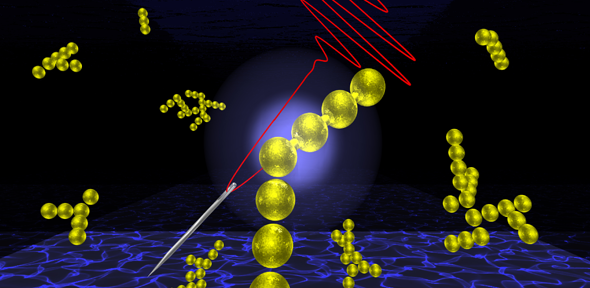
A new technique which uses light like a needle to thread long chains of particles could help bring sci-fi concepts such as cloaking devices one step closer to reality.


                                                          Image Credit: Ventsislav Valev

This level of control opens up a wide range of potential practical applications
A new method of building materials using light, developed by researchers at the University of Cambridge, could one day enable technologies that are often considered the realm of science fiction, such as invisibility cloaks and cloaking devices.
Ventsislav Valev
Although cloaked starships won’t be a reality for quite some time, the technique which researchers have developed for constructing materials with building blocks a few billionths of a metre across can be used to control the way that light flies through them, and works on large chunks all at once. Details are published in the journal Nature Communications.
The key to any sort of ‘invisibility’ effect lies in the way light interacts with a material. When light hits a surface, it is either absorbed or reflected, which is what enables us to see objects. However, by engineering materials at the nanoscale, it is possible to produce ‘metamaterials’: materials which can control the way in which light interacts with them. Light reflected by a metamaterial is refracted in the ‘wrong’ way, potentially rendering objects invisible, or making them appear as something else.
Metamaterials have a wide range of potential applications, including sensing and improving military stealth technology. However, before cloaking devices can become reality on a larger scale, researchers must determine how to make the right materials at the nanoscale, and using light is now shown to be an enormous help in such nano-construction.
The technique developed by the Cambridge team involves using unfocused laser light as billions of needles, stitching gold nanoparticles together into long strings, directly in water for the first time. These strings can then be stacked into layers one on top of the other, similar to Lego bricks. The method makes it possible to produce materials in much higher quantities than can be made through current techniques.
In order to make the strings, the researchers first used barrel-shaped molecules called cucurbiturils (CBs). The CBs act like miniature spacers, enabling a very high degree of control over the spacing between the nanoparticles, locking them in place.
In order to connect them electrically, the researchers needed to build a bridge between the nanoparticles. Conventional welding techniques would not be effective, as they cause the particles to melt. “It’s about finding a way to control that bridge between the nanoparticles,” said Dr Ventsislav Valev of the University’s Cavendish Laboratory, one of the authors of the paper. “Joining a few nanoparticles together is fine, but scaling that up is challenging.”
The key to controlling the bridges lies in the cucurbiturils: the precise spacing between the nanoparticles allows much more control over the process. When the laser is focused on the strings of particles in their CB scaffolds, it produces plasmons: ripples of electrons at the surfaces of conducting metals. These skipping electrons concentrate the light energy on atoms at the surface and join them to form bridges between the nanoparticles. Using ultrafast lasers results in billions of these bridges forming in rapid succession, threading the nanoparticles into long strings, which can be monitored in real time.
“We have controlled the dimensions in a way that hasn’t been possible before,” said Dr Valev, who worked with researchers from the Department of Chemistry, the Department of Materials Science & Metallurgy, and the Donostia International Physics Center in Spain on the project. “This level of control opens up a wide range of potential practical applications.”

- See more at: http://www.cam.ac.uk/research/news/building-invisible-materials-with-light#sthash.HbctmqrE.dpuf

Saturday, 2 February 2013

Man's Mysterious Materials

Photonic Chemistry

A few days ago I mentioned Neal Stephenson's Daimond Age novel, and how synthetic chemists are mimicking Science Fiction, with  new chemicals and materials. I reported new cubic boron hydride crystal that can be harder than diamond.


Here are a few other chemical developments, the first a sinister reflection of another science fiction classic, Cat's Cradle by Kurt Vonnegut.  

Ice-nine is an alternative structure of water that is solid at room temperature. When a crystal of ice-nine contacts liquid water, it becomes a seed crystal that makes the molecules of liquid water arrange themselves into the solid form, ice-nine. Think what that could do to the world's water supply.


On a slightly smaller scale (so far) scientists have created a polymer that is very good at solidifying water.  One kilogram of the polyisocyanide polymer when added to a swimming pool will turn the whole pool solid (or to a jelly anyway). Sounds familiar doesn't it. They admit they haven't actually tried doing the experiment yet: this may be a bad idea. quite a mess to clear up I should think.

On a good note, Japanese scientists have invented a marsh-mallow like sponge based on the chemical  dimethyldimethoxysilane (DMDMS), for mopping up oil that has the unique feature that it can be wrung out. If it could be scaled up sufficiently this could have applications both for oil-spillage and other chemical spills.

Moving from hard to strong materials, other scientists have created the world's strongest fibres. The toughest polymer yarn ever has been made, by mixing a polymer with sheets of reduced graphene oxide (RGOF) and carbon nanotubes (CNTs) during spinning. The yarns can be twisted without breaking or sewn like thread. They can also be coiled into spring shapes.

Finally , more scientists have also produced a Metallic microlattice, the lightest material ever. The new nickel-phosphorus lattice literally is as light as a feather.

These are just a few of the new materials can and will revolutionise the world around us, perhaps leading to a real life Diamond Age.

Photonic Progress: Chemistry


Wednesday, 23 January 2013

Progress: Diamond Age

Photonics Progress

I am a fan of Neal Stephenson, author amongst other novels, of the brilliant historic fiction The Baroque Cycle . 

In this three volume epic, Neal Stephenson sets out how the capitalist economic system of the Western world was created essentially in the 17th and 18th centuries and has persisted essentially unchanged since. The global crisis may have given this thesis a knock perhaps. Time will tell if that will be seen as a blip or the collapse of capitalism. As a Chinese leader answered when asked if the French Revolution was a success, "It's too soon to say." The Baroque Cycle is history with science fiction and perhaps even mystical elements, an explosive alchemy .

This leads me to his earlier novel, the Diamond Age. This is more conventional science fiction,


set in a near future dystropia. Some would say much in the novel has passed into fact already. One aspect of the wide-ranging plot is the army of nano-technology 'bots' that construct complex diamond architectures that is amazingly fine and strong. This came to my mind in reading an article in Scientific American that describes a new diamond-like compound being synthesised that is stronger and can cut diamond, cubic boron nitride . Scaling up may be an issue, but the march to produce stronger and more light materials is well under way. 

Nanobots shortly will be on the march, I will add.

Finally consider signing the petition to save the Royal Institution, that was founded in London in 1799, which brings me back to the story of the Baroque Cycle.

Photonic Progress (Chemistry)


Tuesday, 22 January 2013

Progress: Flu vaccine without smashing eggs

Photonics Health

It may take breaking eggs to make omelettes, but are you aware that making conventional flu vaccines requires millions of fertilised eggs each year? As well as a major headache (for the hen) this also may mean the vaccine is unsuitable for those with egg allergies. 

Until now that is. 

Flublok from US biotech Protein Sciences has become the first flu vaccine made using an insect virus to win marketing approval in the US. Growing the virus in cell lines, unlike eggs, means cells can be frozen for later use, possibly reacting more quickly to emergencies. In November 2012, the FDA approved Flucelvax from Novartis. This was the first vaccine based on cell lines, rather than eggs, to reach the market. Flublok differs as it does not require flu viruses. It contains three, full-length, recombinant haemagglutinin proteins. This increases protection against two influenza virus A strains, H1N1 and H3N2, and one influenza virus B strain. 

The hen can relax!


Photo credit: Nina Matthews Photography / Foter.com / CC BY


 Source: Chemistry World

Photonics Health