Showing posts with label planets. Show all posts

Saturday, 14 June 2014

Astronomers Confounded By Massive Rocky World, Kepler-10c


Kepler-10 System
An artist's conception shows the Kepler-10 system, home to two rocky planets. In the foreground is Kepler-10c, a planet that weighs 17 times as much as Earth and is more than twice as large in size. Planet formation theorists are challenged to explain how such a massive world could have formed.

Astronomers have discovered a rocky planet that weighs 17 times as much as Earth and is more than twice as large in size. This discovery has planet formation theorists challenged to explain how such a world could have formed.
"We were very surprised when we realized what we had found," said astronomer Xavier Dumusque of the Harvard-Smithsonian Center for Astrophysics, Cambridge, Massachusetts, who led the analysis using data originally collected by NASA's Kepler space telescope.
Kepler-10c, as the planet had been named, had a previously measured size of 2.3 times larger than Earth, but its mass was not known until now. The team used the HARPS-North instrument on the Telescopio Nazionale Galileo in the Canary Islands to conduct follow-up observations to obtain a mass measurement of the rocky behemoth.
It was thought worlds such as this could not possibly exist. The enormous gravitational force of such a massive body would accrete a gas envelope during formation, ballooning the planet to a gas giant the size of Neptune or even Jupiter. However, this planet is thought to be solid, composed primarily of rock.
"Just when you think you've got it all figured out, nature gives you a huge surprise -- in this case, literally," said Natalie Batalha, Kepler mission scientist at NASA's Ames Research Center in Moffett Field, California. "Isn't science marvelous?"
Kepler-10c orbits a sun-like star every 45 days, making it too hot to sustain life as we know it. It is located about 560 light-years from Earth in the constellation Draco. The system also hosts Kepler-10b, the first rocky planet discovered in the Kepler data.
The finding was presented at a meeting of the American Astronomical Society in Boston. Read more about the discovery in the Harvard-Smithsonian Center for Astrophysics news release.
NASA's Ames Research Center manages Kepler's ground system development, mission operations and science data analysis. NASA's Jet Propulsion Laboratory, Pasadena, California, managed the Kepler mission's development.
Ball Aerospace and Technologies Corp. in Boulder, Colorado, developed the Kepler flight system and supports mission operations with the Laboratory for Atmospheric and Space Physics at the University of Colorado in Boulder.
The Space Telescope Science Institute in Baltimore archives, hosts and distributes Kepler science data. Kepler is NASA's 10th Discovery Mission and is funded by NASA's Science Mission Directorate at the agency's headquarters in Washington.
Credit NASA/JPL
For more information about the Kepler mission, visit:
For more information about exoplanets and NASA's planet-finding program, visit:

Thursday, 9 May 2013

Visions of Exoplanets: NASA report


In a new JPL report, Whitney Clavin gives an update on the imaging of exoplanets: impossible magic, or so we would have thought a generation ago. 
This image shows the HR 8799 planets with starlight optically suppressed and data processing conducted to remove residual starlight. The star is at the center of the blackened circle in the image. The four spots indicated with the letters b through e are the planets. This is a composite image using 30 wavelengths of light and was obtained over a period of 1.25 hours on June 14 and 15, 2012. Image courtesy of Project 1640 (NASA)
Gone are the days of being able to count the number of known planets on your fingers. Today, there are more than 800 confirmed exoplanets -- planets that orbit stars beyond our sun -- and more than 2,700 other candidates. What are these exotic planets made of? Unfortunately, you cannot stack them in a jar like marbles and take a closer look. Instead, researchers are coming up with advanced techniques for probing the planets' makeup. 

One breakthrough to come in recent years is direct imaging of exoplanets. Ground-based telescopes have begun taking infrared pictures of the planets posing near their stars in family portraits. But to astronomers, a picture is worth even more than a thousand words if its light can be broken apart into a rainbow of different wavelengths.

Those wishes are coming true as researchers are beginning to install infrared cameras on ground-based telescopes equipped with spectrographs. Spectrographs are instruments that spread an object's light apart, revealing signatures of molecules. Project 1640, partly funded by NASA's Jet Propulsion Laboratory, Pasadena, Calif., recently accomplished this goal using the Palomar Observatory near San Diego.

"In just one hour, we were able to get precise composition information about four planets around one overwhelmingly bright star," said Gautam Vasisht of JPL, co-author of the new study appearing in the Astrophysical Journal. "The star is a hundred thousand times as bright as the planets, so we've developed ways to remove that starlight and isolate the extremely faint light of the planets."

Along with ground-based infrared imaging, other strategies for combing through the atmospheres of giant planets are being actively pursued as well. For example, NASA's Spitzer and Hubble space telescopes monitor planets as they cross in front of their stars, and then disappear behind. NASA's upcoming James Webb Space Telescope will use a comparable strategy to study the atmospheres of planets only slightly larger than Earth.

In the new study, the researchers examined HR 8799, a large star orbited by at least four known giant, red planets. Three of the planets were among the first ever directly imaged around a star, thanks to observations from the Gemini and Keck telescopes on Mauna Kea, Hawaii, in 2008. The fourth planet, the closest to the star and the hardest to see, was revealed in images taken by the Keck telescope in 2010.

That alone was a tremendous feat considering that all planet discoveries up until then had been made through indirect means, for example by looking for the wobble of a star induced by the tug of planets.

Those images weren't enough, however, to reveal any information about the planets' chemical composition. That's where spectrographs are needed -- to expose the "fingerprints" of molecules in a planet's atmosphere. Capturing a distant world's spectrum requires gathering even more planet light, and that means further blocking the glare of the star.

Project 1640 accomplished this with a collection of instruments, which the team installs on the ground-based telescopes each time they go on "observing runs." The instrument suite includes a coronagraph to mask out the starlight; an advanced adaptive optics system, which removes the blur of our moving atmosphere by making millions of tiny adjustments to two deformable telescope mirrors; an imaging spectrograph that records 30 images in a rainbow of infrared colors simultaneously; and a state-of-the-art wave front sensor that further adjusts the mirrors to compensate for scattered starlight.

"It's like taking a single picture of the Empire State Building from an airplane that reveals a bump on the sidewalk next to it that is as high as an ant," said Ben R. Oppenheimer, lead author of the new study and associate curator and chair of the Astrophysics Department at the American Museum of Natural History, N.Y., N.Y.

Their results revealed that all four planets, though nearly the same in temperature, have different compositions. Some, unexpectedly, do not have methane in them, and there may be hints of ammonia or other compounds that would also be surprising. Further theoretical modeling will help to understand the chemistry of these planets.

Meanwhile, the quest to obtain more and better spectra of exoplanets continues. Other researchers have used the Keck telescope and the Large Binocular Telescope near Tucson, Ariz., to study the emission of individual planets in the HR8799 system. In addition to the HR 8799 system, only two others have yielded images of exoplanets. The next step is to find more planets ripe for giving up their chemical secrets. Several ground-based telescopes are being prepared for the hunt, including Keck, Gemini, Palomar and Japan's Subaru Telescope on Mauna Kea, Hawaii.

Ideally, the researchers want to find young planets that still have enough heat left over from their formation, and thus more infrared light for the spectrographs to see. They also want to find planets located far from their stars, and out of the blinding starlight. NASA's infrared Spitzer and Wide-field Infrared Survey Explorer (WISE) missions, and its ultraviolet Galaxy Evolution Explorer, now led by the California Institute of Technology, Pasadena, have helped identify candidate young stars that may host planets meeting these criteria.

"We're looking for super-Jupiter planets located faraway from their star," said Vasisht. "As our technique develops, we hope to be able to acquire molecular compositions of smaller, and slightly older, gas planets."

Still lower-mass planets, down to the size of Saturn, will be targets for imaging studies by the James Webb Space Telescope.

"Rocky Earth-like planets are too small and close to their stars for the current technology, or even for James Webb to detect. The feat of cracking the chemical compositions of true Earth analogs will come from a future space mission such as the proposed Terrestrial Planet Finder," said Charles Beichman, a co-author of the P1640 result and executive director of NASA's Exoplanet Science Institute at Caltech.

Though the larger, gas planets are not hospitable to life, the current studies are teaching astronomers how the smaller, rocky ones form.

"The outer giant planets dictate the fate of rocky ones like Earth. Giant planets can migrate in toward a star, and in the process, tug the smaller, rocky planets around or even kick them out of the system. We're looking at hot Jupiters before they migrate in, and hope to understand more about how and when they might influence the destiny of the rocky, inner planets," said Vasisht.

NASA's Exoplanet Science Institute manages time allocation on the Keck telescope for NASA. JPL manages NASA's Exoplanet Exploration program office. Caltech manages JPL for NASA. 

A visualization from the American Museum of Natural History showing where the HR 8799 system is in relation to our solar system is online at http://www.youtube.com/watch?v=yDNAk0bwLrU . 

More information about exoplanets and NASA's planet-finding program is at http://planetquest.jpl.nasa.gov .
Photonic Space

Monday, 11 February 2013

Alpha Centauri and a 'plug' for the Planetary Society

Photonic Space

Yesterday in my blog on earth-like planets and potential civilizations in space I touched on the discovery of a rocky planet in the orbit of our close neighbour, Alpha Centauri B. Here are a few facts. 

The planet is about the size of earth but is travels fast, circling its star in just 3.24 days. For comparison, Mercury's orbit lasts 88 days.

The planet is much closer to its star than the earth is, at a distance of just about six million kilometers,compared to Mercury which is about 46 million kilometers from our sun at its nearest point of its orbit. The new planet therefore must be hellishly hot.  


The search is on for other rocky planets in the habitable zone that could support life, including looking for more planets around Alpha centauri. 

I have no official involvement at all with the Planetary Society, a society  based in Pasadena. However I know they do admirable work so I hope they won't mind me giving them a plug. If you are interested in the search for new earth-like planets you may wish to visit their web site and perhaps even consider joining the Planetary Society or giving them a donation. 

I am told that just $20 US will purchase for them six minutes rental time on a telescope to study Alpha centauri.

Photonic Space


Sunday, 3 February 2013

Space: Habitable Exoplanets Catalog

Photonic Space

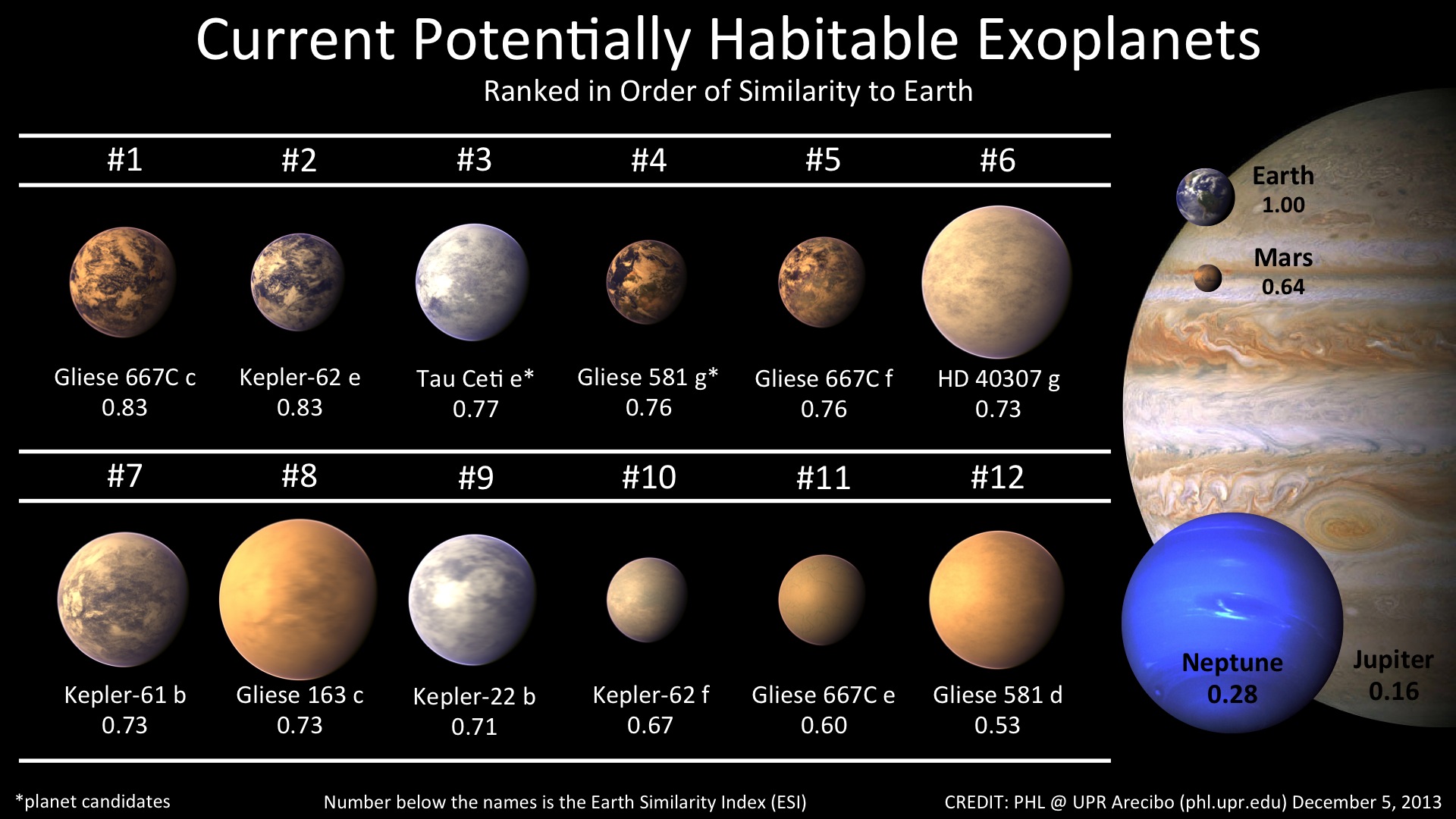
Following discussing exoplanet mapping yesterday, here is a fantastic catalogue of exoplanets. You might like to visit this site for more details and other links to those pioneers of this new branch of space science, and of course to see the number of potential planets steadily increase over time.

The Habitable Exoplanets Catalog (HEC) is an online database for scientists, educators, and the general public focused on potential habitable exoplanets discoveries. The catalog uses various habitability indices and classifications to identify, rank, and compare exoplanets, including potential satellites, or exomoons. The catalog is updated as new data is available.

"Scientists are looking for life, as we know it, on Earth-like planets, as we measure them."

A New Habitable Zone: Earth is situated at the very inner edge of the habitable zone

Last Update: January 29, 2013
Click image for more details, click here for larger version.


Number of Potential Habitable Worlds

Potential
Habitable Exoplanets
Unconfirmed Potential
Habitable Exoplanets (1)
Candidates for Potential
Habitable Exomoons (2)
η Earth(3)
930301.6 %


All Currently Known Exoplanets


Confirmed Exoplanets (4)NASA Kepler Candidates (5)Other Unconfirmed Exoplanets (4)
8652740186


Notes

(1) Based on NASA Kepler Mission exoplanet candidates waiting for confirmation.
(2) Estimate based on the number of warm jovians with the right mass for a near Earth-size moon. None observed yet.

(3) Î· Earth (Eta Earth) is the stellar frequency of potential habitable exoplanets based on observed values (this is a lower limit).
(4) Confirmed and unconfirmed exoplanets are those listed by the Extrasolar Planets Encyclopedia plus any recent pending additions.
(5) Most of NASA Kepler Candidates are unconfirmed exoplanets.

Photonic Space

Saturday, 2 February 2013

Photonics Space: How to Map Distant Exoplanets


Can we start mapping the surfaces of distant planets?


As of 2 January 2013,  astronomers state that the Milky Way Galaxy may contain as many as 400 billion exoplanets, with almost every star hosting at least one planet.[1][2][3]


Milky Way Galaxy (NASA)

Over 860 distant exoplanets so far have been identified, and we know the atmospheric composition of many of these planets from their spectral shifts. But can we actually see landmass and oceans? Not yet but soon! 

Space scientist Nicolas Cowan says he knows how to do it.
This EPOXI mission image shows what an Earth-like exoplanet might look like.
Image credit: 
 ASA/JPL-Caltech/UMD/GSFC EPOXI | EPOXI
Extrasolar cartography' technique could provide rough pictures of  alien worlds.

Astronomers could one day create rough maps of far-away planets using information taken from starlight reflection, determining the balance of oceans, lands and overhanging clouds.

The software can take a point of reflected starlight from an exoplanet to tease apart the unique signals required to form a rough map. Developed by planetary scientist Nicolas Cowan and presented this month at a meeting of the American Astronomical Society in Long Beach, Calif., it is inspired by a technique originally developed to distinguish between natural surfaces – such as forests – and unnatural ones like military bunkers in satellite images of Earth.
Because there is currently no telescope powerful enough to directly photograph a faraway rocky planet, Cowan tested the software on images of Earth taken from a distant vantage point in space by NASA's Deep Impact spacecraft as part of the EPOXI mission.
"The object of this experiment was to see whether we could identify the colors of surfaces on Earth, [and tell] how many major surfaces are there, and what they look like," said Cowan, who works at Northwestern University in Evanston, Ill.
Cowan's technique – called "rotational unmixing" – analyzes the changing color of starlight reflecting off a distant, spinning exoplanet to calculate the mix of planetary features – such as land or ocean – that might combine to create a specific hue.
The technique is similar to being in an otherwise dark room with a muted television and analyzing the light reflected on the opposite wall to figure what is playing on the TV.
"You're not seeing the picture, but you're seeing the reflection of the picture and learning something about what's going on there," said Eric Ford, an astronomer at the University of Florida in Gainesville, who was not involved in the study.
When Cowan's software was applied to EPOXI images of Earth, it was able to extract reflectance signatures corresponding to three major surface types.
"The analysis told us there were three important features," Cowan said, "and their spectra look an awful lot like land, ocean, and clouds."
Lisa Kaltenegger, an exoplanet researcher at the Max-Planck Institute for Astronomy in Heidelberg, Germany, said Cowan's technique was very interesting– but with a few caveats. For example, the exoplanet must have highly contrasting surfaces, such as ocean and land, or ocean and clouds, for this technique to work well.
"If you have an ocean planet or a planet that is all land, it would be very challenging because you don't have different surfaces," said Kaltenegger, who also did not participate in the study.
Another challenge would be distinguishing between clouds and ice on a planet's surface, according to Aomawa Shields, an astrobiologist at the University of Washington in Seattle who was not involved in the study.
"Being able to tell whether a planet is simply undergoing significant cloud cover, or is in the midst of a global glaciation is important from the standpoint of habitability," Shields said.
If the right planet could be found, however, the rotational unmixing technique could give astronomers a rough idea of the ocean-to-land ratio of an exoplanet, or provide a sense of what the climate is like by analyzing cloud cover and cloud movement.
The resulting picture would not be a map in the traditional sense.  "It's not like a map that you can use to land a spacecraft on a planet ... but it's better than nothing," Cowan said.
Before astronomers can apply the technique to a real exoplanet, they will first need a telescope with a lens that is not only big enough to resolve the pinprick of reflected light from a distant world, but powerful enough to extract meaningful data from short-period observations lasting only hours – the time it takes for an Earth-like planet to make a complete turn.
"You need a next-gen telescope," Cowan said. "We're talking like early 2020s realistically."
The task could be simplified if a target exoplanet rotated slower than Earth, or if it was located relatively close to us, so that it appeared bigger than it would otherwise.
Fortunately, recent discoveries by NASA's Kepler mission suggest the galaxy is teeming with planets. Astronomers estimate the Milky Way contains at least 100 billion planets, and that at least 1-in-17 sunlike stars have Earth-sized, rocky worlds circling around them.
"The good news is it's not like we're going to have to look halfway across the galaxy to find some cool planets to study," Ford said.
Originally published: 
Jan 29 2013 - 2:00pm
 By: 
Ker Than, ISNS Contributor
(ISNS)
Photonic Space

Sunday, 20 January 2013

Space: Frost on Mars and more

Photonics Space: Image of Frost on Mars

Good Morning from a snowy England. There are some colourful space images in the Guardian newspaper, including a great view of frost-covered craters on Mars  images 

Also featured is the iconic JPL NASA Cassini image of Saturn in shade. The NASA/JPL site describes why this looks this way.