Showing posts with label earth. Show all posts

Saturday, 14 June 2014

Milky Way may bear 100 million life-giving planets, a whole lot of aliens?

This blog has speculated several times (e.g. here) about the probability of life elsewhere in the universe. A new study from Cornell University puts the number of possible life-supporting planets (in our own Milky Way galaxy alone) at about 100 million. On the face of it less than my own 'gestimate' but still pointing to a whole lot of aliens!


Planetary Habitability Laboratory, University of Puerto Rico at Arecibo

Here is their news report:


There are some 100 million other places in the Milky Way galaxy that could support complex life, report a group of university astronomers in the journal Challenges. They have developed a new computation method to examine data from planets orbiting other stars in the universe.
Their study provides the first quantitative estimate of the number of worlds in our galaxy that could harbor life above the microbial level.
“This study does not indicate that complex life exists on that many planets. We’re saying that there are planetary conditions that could support it. Origin of life questions are not addressed – only the conditions to support life,” according to the paper’s authors Alberto Fairén, Cornell research associate; Louis Irwin, University of Texas at El Paso (lead author); Abel Méndez, University of Puerto Rico at Arecibo; and Dirk Schulze-Makuch, Washington State University.
Alberto Fairen
Fairen
“Complex life doesn’t mean intelligent life – though it doesn’t rule it out or even animal life – but simply that organisms larger and more complex than microbes could exist in a number of different forms. For example, organisms that form stable food webs like those found in ecosystems on Earth,” the researchers explain in an auxiliary statement.
The scientists surveyed more than 1,000 planets and used a formula that considers planet density, temperature, substrate (liquid, solid or gas), chemistry, distance from its central star and age. From this information, they developed and computed the Biological Complexity Index (BCI).
The BCI calculation revealed that 1 to 2 percent of the planets showed a BCI rating higher than Europa, a moon of Jupiter thought to have a subsurface global ocean that may harbor forms of life. With about 10 billion stars in the Milky Way galaxy, the BCI yields 100 million plausible planets.
Despite the large number of planets that could harbor complex life, the Milky Way is so vast that planets with high BCI values are very far apart, according to the scientists. One of the closest and most promising extrasolar systems, called Gliese 581, has two planets with the apparent, possible capacity to host complex biospheres. The distance from Earth to Gliese 581 is about 20 light years.
“It seems highly unlikely that we are alone,” say the researchers. “We are likely so far away from life at our level of complexity that a meeting with such alien forms might be improbable for the foreseeable future.”
The research, “Assessing the Possibility of Biological Complexity on Other Worlds, With an Estimate of the Occurrence of Complex Life in the Milky Way Galaxy,” in Challenges, received no external funding.

credit

Tuesday, 18 June 2013

Cassini Probe to Take Photo of Earth From Deep Space


NASA's Cassini spacecraft, now exploring Saturn, will take a picture of our home planet from a distance of hundreds of millions of miles on July 19. NASA is inviting the public to help acknowledge the historic interplanetary portrait as it is being taken. 


This simulated view from NASA's Cassini spacecraft shows the expected positions of Saturn and Earth on July 19, 2013, around the time Cassini will take Earth's picture. Cassini will be about 898 million miles (1.44 billion kilometers) away from Earth at the time. That distance is nearly 10 times the distance from the sun to Earth. Image credit: NASA/JPL-Caltech 

Earth will appear as a small, pale blue dot between the rings of Saturn in the image, which will be part of a mosaic, or multi-image portrait, of the Saturn system Cassini is composing.

"While Earth will be only about a pixel in size from Cassini's vantage point 898 million [1.44 billion kilometers] away, the team is looking forward to giving the world a chance to see what their home looks like from Saturn," said Linda Spilker, Cassini project scientist at NASA's Jet Propulsion Laboratory in Pasadena, Calif. "We hope you'll join us in waving at Saturn from Earth, so we can commemorate this special opportunity."

Cassini will start obtaining the Earth part of the mosaic at 2:27 p.m. PDT (5:27 p.m. EDT or 21:27 UTC) and end about 15 minutes later, all while Saturn is eclipsing the sun from Cassini's point of view. The spacecraft's unique vantage point in Saturn's shadow will provide a special scientific opportunity to look at the planet's rings. At the time of the photo, North America and part of the Atlantic Ocean will be in sunlight.

Unlike two previous Cassini eclipse mosaics of the Saturn system in 2006, which captured Earth, and another in 2012, the July 19 image will be the first to capture the Saturn system with Earth in natural color, as human eyes would see it. It also will be the first to capture Earth and its moon with Cassini's highest-resolution camera. The probe's position will allow it to turn its cameras in the direction of the sun, where Earth will be, without damaging the spacecraft's sensitive detectors.

"Ever since we caught sight of the Earth among the rings of Saturn in September 2006 in a mosaic that has become one of Cassini's most beloved images, I have wanted to do it all over again, only better," said Carolyn Porco, Cassini imaging team lead at the Space Science Institute in Boulder, Colo. "This time, I wanted to turn the entire event into an opportunity for everyone around the globe to savor the uniqueness of our planet and the preciousness of the life on it."

Porco and her imaging team associates examined Cassini's planned flight path for the remainder of its Saturn mission in search of a time when Earth would not be obstructed by Saturn or its rings. Working with other Cassini team members, they found the July 19 opportunity would permit the spacecraft to spend time in Saturn's shadow to duplicate the views from earlier in the mission to collect both visible and infrared imagery of the planet and its ring system.

"Looking back towards the sun through the rings highlights the tiniest of ring particles, whose width is comparable to the thickness of hair and which are difficult to see from ground-based telescopes," said Matt Hedman, a Cassini science team member based at Cornell University in Ithaca, N.Y., and a member of the rings working group. "We're particularly interested in seeing the structures within Saturn's dusty E ring, which is sculpted by the activity of the geysers on the moon Enceladus, Saturn's magnetic field and even solar radiation pressure."

This latest image will continue a NASA legacy of space-based images of our fragile home, including the 1968 "Earthrise" image taken by the Apollo 8 moon mission from about 240,000 miles (380,000 kilometers) away and the 1990 "Pale Blue Dot" image taken by Voyager 1 from about 4 billion miles (6 billion kilometers) away.

The Cassini-Huygens mission is a cooperative project of NASA, the European Space Agency and the Italian Space Agency. JPL manages the Cassini-Huygens mission for NASA's Science Mission Directorate in Washington, and designed, developed and assembled the Cassini orbiter and its two onboard cameras. The imaging team consists of scientists from the United States, the United Kingdom, France and Germany. The imaging operations center is based at the Space Science Institute in Boulder, Colo.

To learn more about the public outreach activities associated with the taking of the image, visit:http://saturn.jpl.nasa.gov/waveatsaturn .

For more information about Cassini, visit http://www.nasa.gov/cassini and http://saturn.jpl.nasa.gov .

Jia-Rui C. Cook 818-354-0850
Jet Propulsion Laboratory, Pasadena, Calif.
jccook@jpl.nasa.gov

Dwayne Brown 202-358-1726
NASA Headquarters, Washington
dwayne.c.brown@nasa.gov 
Photonic Space

Sunday, 21 April 2013

Kepler estimates 17 billion earth sized worlds in our galaxy


The results of a new analysis of Kepler data show that one in six stars has an Earth-sized planet in a tight orbit. About a fourth of all stars in the Milky Way have a super-Earth, and the same fraction have a mini-Neptune. Only about 3 percent of stars have a large Neptune, and only 5 percent a gas giant at the orbital distances studied. Credit: F. Fressin (CfA)

An illustration of a number of the different kinds of planets found by Kepler all lined up in a row.Click for full resolution
This artist's illustration represents the variety of planets being detected by NASA's Kepler spacecraft. A new analysis has determined the frequencies of planets of all sizes, from Earths up to gas giants. Key findings include the fact that one in six stars hosts an Earth-sized planet in an orbit of 85 days or less, and that almost all sun-like stars have a planetary system of some sort. (Hat tip to Robert Hurt for inspiring this illustration.) Credit: C. Pulliam & D. Aguilar (CfA)
The latest Kepler information indicates there are 17 billion earth like planets in the milky way:  incidentally that is about ten times my own highly speculative estimate in February.

The quest to determine if planets like Earth are rare or common is taking another stride forward on the journey. Using NASA's Kepler spacecraft, managed by NASA Ames Research Center, astronomers are beginning to find Earth-sized planets orbiting distant stars. A new analysis of Kepler data shows that about 17 percent of stars have an Earth-sized planet in an orbit closer than Mercury. Since the Milky Way has about 100 billion stars, there are at least 17 billion Earth-sized worlds out there.

Francois Fressin, of the Harvard-Smithsonian Center for Astrophysics (CfA), presented the analysis today in a press conference at a meeting of the American Astronomical Society in Long Beach, Calif. A paper detailing the research has been accepted for publication in The Astrophysical Journal.

The research team found that 50 percent of all stars have a planet of Earth-size or larger in a close orbit. By adding larger planets detected in wider orbits up to the orbital distance of the Earth, this number increases to 70 percent.

Extrapolating from Kepler's currently ongoing observations and results from other detection techniques, scientists have determined that nearly all sun-like stars have planets.

Planets closer to their stars are easier to find because they transit more frequently. As more data are gathered, planets in larger orbits will be detected. In particular, Kepler's extended mission will enable the detection of Earth-sized planets at greater distances, including Earth-like orbits in the "habitable zone," the region in a planetary system where liquid water might exist on the surface of an orbiting planet.

Kepler is the first NASA mission capable of finding Earth-size planets orbiting in or near the habitable zone of the host star. NASA's Ames Research Center, Moffett Field, Calif., is the home organization of the science principal investigator, and is responsible for the ground system development, mission operations, and science data analysis.

NASA's Jet Propulsion Laboratory in Pasadena, Calif., managed Kepler mission development. Ball Aerospace and Technologies Corp. in Boulder, Colo., developed the Kepler flight system and supports mission operations with JPL at the Laboratory for Atmospheric and Space Physics at the University of Colorado in Boulder.

The Space Telescope Science Institute in Baltimore archives, hosts and distributes the Kepler science data. Kepler is NASA's 10th Discovery Mission and is funded by NASA's Science Mission Directorate at the agency's headquarters.

To read more about the discovery, see the Harvard-Smithsonian Center for Astrophysics press release.

Read more about the Kepler Mission.
 
 
Michele Johnson
Ames Research Center, Moffett Field, Calif.
650-604-6982
michele.johnson@nasa.gov
 

Monday, 11 February 2013

Alpha Centauri and a 'plug' for the Planetary Society

Photonic Space

Yesterday in my blog on earth-like planets and potential civilizations in space I touched on the discovery of a rocky planet in the orbit of our close neighbour, Alpha Centauri B. Here are a few facts. 

The planet is about the size of earth but is travels fast, circling its star in just 3.24 days. For comparison, Mercury's orbit lasts 88 days.

The planet is much closer to its star than the earth is, at a distance of just about six million kilometers,compared to Mercury which is about 46 million kilometers from our sun at its nearest point of its orbit. The new planet therefore must be hellishly hot.  


The search is on for other rocky planets in the habitable zone that could support life, including looking for more planets around Alpha centauri. 

I have no official involvement at all with the Planetary Society, a society  based in Pasadena. However I know they do admirable work so I hope they won't mind me giving them a plug. If you are interested in the search for new earth-like planets you may wish to visit their web site and perhaps even consider joining the Planetary Society or giving them a donation. 

I am told that just $20 US will purchase for them six minutes rental time on a telescope to study Alpha centauri.

Photonic Space


Saturday, 9 February 2013

Earth Like Planets and Civilizations in Space

Photonic Space

A recent article in Space.com provide some interesting current estimates about the numbers of earth-like exoplanets. Based on these calculations the nearest earth-like planet may be 13 light years away. That is small be astronomic standards but I would pack a suitcase for the trip. 

The data is based on that generated from the NASA  Kepler space telescope, which scans more than 150,000 stars simultaneously.  Planets are shown by  temporary dips in brightness when they pass in front, or transit, their stars. Of  3897 red dwarfs (smaller than our sun) Kepler identified 95 exoplanets and three 'earth-like' planets (that might possibly support life.) From this data scientists estimate about 6 percent of red dwarfs in the Milky Way galaxy should host Earth-like planets. (In my view that's more like a 'guesstimate' than an estimate, more on that line later). About 75 percent of our Milky Way galaxy's 100 billion stars are red dwarfs. Doing the sums this suggests 4.5 billion "Alien Earths" spread throughout the galaxy. Within 30 light-years of our sun there are 248 red dwarfs, according to separate Research Consortium on Nearby Stars led by Georgia State University.


A cartoon representation imagines a star field filled with planetary systems.Image: ESO/M. Kornmesser


The closest red dwarf to Earth is Proxima Centauri, which is 4.2 light-years away in the three-star Alpha Centauri system. Although Proxima hasn't been demonstrated to have an earth-like plane, its neighbour Alpha Centauri does have an earth-sized planet, admittedly on the hot side for supporting life as we know it.
The above is based on the full article by Elizabeth Howell @howellspace,  SPACE.com @Spacedotcom.

My thoughts

It is possible to further estimate how many planets will have intelligent life. I recall Carl Sagan doing a similar calculation based on an equation of the astronomer, Frank Drake. This was some thirty years ago, when we believed planets were much rarer and in any case might be too small to ever be identifiable from the Earth.

These are my figures entirely:

Lets work with this best estimate of 4.5 billion earth like planets in the Milky Way. Of course there are almost countless other galaxies, but identifying life there is much less likely in the near future.

How may of these earth-like planets are likely to be capable of sustaining life as we know it, e.g. at least microbial? If they are earth-like I would say quit a lot, let's say 40% for argument, or 1.8 billion planets. 

Of these how may will have developed life? Good question! I would suggest most would given a suitable environment. Of course there may be factors to prevent this such as radiation, but again lets say about half. That makes 0.9 billion planets with life.

Of these, how may would have developed a technological civilization? (As we have only been at this stage for a few hundred years,  if they have got that far almost all in fact will be more technologically advanced than we are.) 
Lets say 10% will be technologically advanced, which leaves 90 million worlds with intelligent life in advance of our own. (I am using US billions, i.e thousand millions, rather than British millions, which are million millions).

How may worlds got to about our stage and then survived the atomic age? After all our own doomsday clock on earth is edging nearer to midnight. Despite that I am optimistic that most would find a path not to end their civilizations. Lets say 80% of civilizations survive. 

So we conclude there are 72 million planets with advanced intelligent species in the Milky Way.

Of course some will be space-travelers and may have colonized other worlds. Lets say 10 colonized worlds on average. May be more, may be less. But then they may have wiped out some alien life during this colonization, so perhaps let's say five new colonized worlds on average per civilisation. That gives us a final figure of 360 million planets with civilizations ahead of ours.

Why haven't any of the 360 million civilizations contacted the earth? Perhaps they have. Perhaps they will. Perhaps as Mike Oldfield said we are 'on this small planet lost in space', i.e. we are in a quiet spot on the edge of great cultures that haven't looked this way yet.
   
Time will tell if I am more or less accurate than in Jeff Wayne's musical version of H G Wells' War of the Worlds.

'The chances of anyone coming from Mars is a million to one, and yet they come.'

Allusions in the Text


Photonic Space

p.s. Mathematics isn't my strongest point. Please let me know if you think I missed anything.


Sunday, 3 February 2013

Space News: Asteroid has Missed Earth on 15 February

Photonic Space

Update:

As of the evening of 15 February (GMT) asteroid DA14 has passed the earth. 

There was a scare this morning when we turned on the news. A meteor had streaked through the skies over Russia's Urals region this morning, then exploded causing many injuries. Here is a link to the BBC report.

Scientists have determined the Russia meteor is not related to asteroid 2012 DA14, which a few hours later safely passed Earth today at a distance of more than 17,000 miles (27,360 kilometers). Early assessments of the Russia meteor indicate it was about one-third the size of 2012 DA14 and traveling in a different direction. 

I will retain this blog as a historic record of a dramatic day in near-earth space.

--------------------------------------------------------------------------------
NASA has announced that a small asteroid will safely miss the Earth on February 15. 

The small near-Earth asteroid 2012 DA14 will pass very close to Earth on February 15, so close that it will pass inside the ring of geosynchronous weather and communications satellites. NASA's Near-Earth Object Program Office can accurately predict the asteroid's path with the observations obtained, and it is therefore known that there is no chance that the asteroid might be on a collision course with Earth. Nevertheless, the flyby will provide a unique opportunity for researchers to study a near-Earth object up close.

Asteroid 2012 DA14 will be closest to Earth on Feb. 15, at about 11:24 p.m. PST (2 p.m. EST and 1924 UT), when it will be at a distance of about 27,700 kilometers (17,200 miles) above Earth's surface. Although this is close enough for the asteroid to pass inside the ring of geosynchronous satellites, located about 35,800 kilometers (22,200 miles) above the equator, it will still be well above the vast majority of satellites, including the International Space Station. At its closest, the asteroid will be only about 1/13th of the distance to the moon. The asteroid will fly by our planet quite rapidly, at a speed of about 17,400 mph (7.8 kilometers per second) in a south-to-north direction with respect to Earth.

Even though 2012 DA14 is coming remarkably close, it will still only appear as a point of light in the biggest of optical telescopes, because of its small size. Based on its brightness, astronomers estimate that it is only about 45 meters (150 feet) across. It will brighten only to magnitude 7.5, too faint to be seen with the naked eye, but easily visible with a good set of binoculars or a small telescope. The best viewing location for the closest approach will be Indonesia, from which the asteroid will be seen to move at a rate of almost 1 degree per minute against the star background. Eastern Europe, Asia and Australia are also well situated to see the asteroid around its closest approach. But by the time Earth rotates enough for observers in the continental United States to have a chance to see the asteroid, it will have receded and faded to about the 11th magnitude. Radar astronomers plan to take images of the asteroid about eight hours after closest approach using the Goldstone antenna in California's Mojave Desert, which is part of NASA's Deep Space Network.

2012 DA14 has not been in the catalogues for very long -- it was discovered in February of 2012 by astronomers at the La Sagra Sky Survey program in southern Spain and reported to the Minor Planet Center, which designates minor bodies in our solar system. At the time of the discovery, the asteroid had just made a fairly distant passage by Earth, about seven times farther than the distance to the moon. Since 2012 DA14's orbital period around the sun has been about 368 days, which is very similar to Earth's, the asteroid made a series of annual close approaches. This year's is the closest approach, and is the closest the asteroid will come for at least three decades. But this encounter will shorten 2012 DA14's orbital period to about 317 days, changing its orbital class from Apollo to Aten, and its future close approaches will follow a different pattern.

This passage of 2012 DA14 by Earth is a record close approach for a known object of this size. A few other known asteroids have flown by Earth even closer, but those asteroids were smaller. On average, we expect an object of this size to get this close to Earth about once every 40 years. An actual Earth collision by an object of this size would be expected much less frequently, about once every 1,200 years, on average.
Image of the giant asteroid Vesta taken by the Dawn Mission (NASA)

Photonic Space

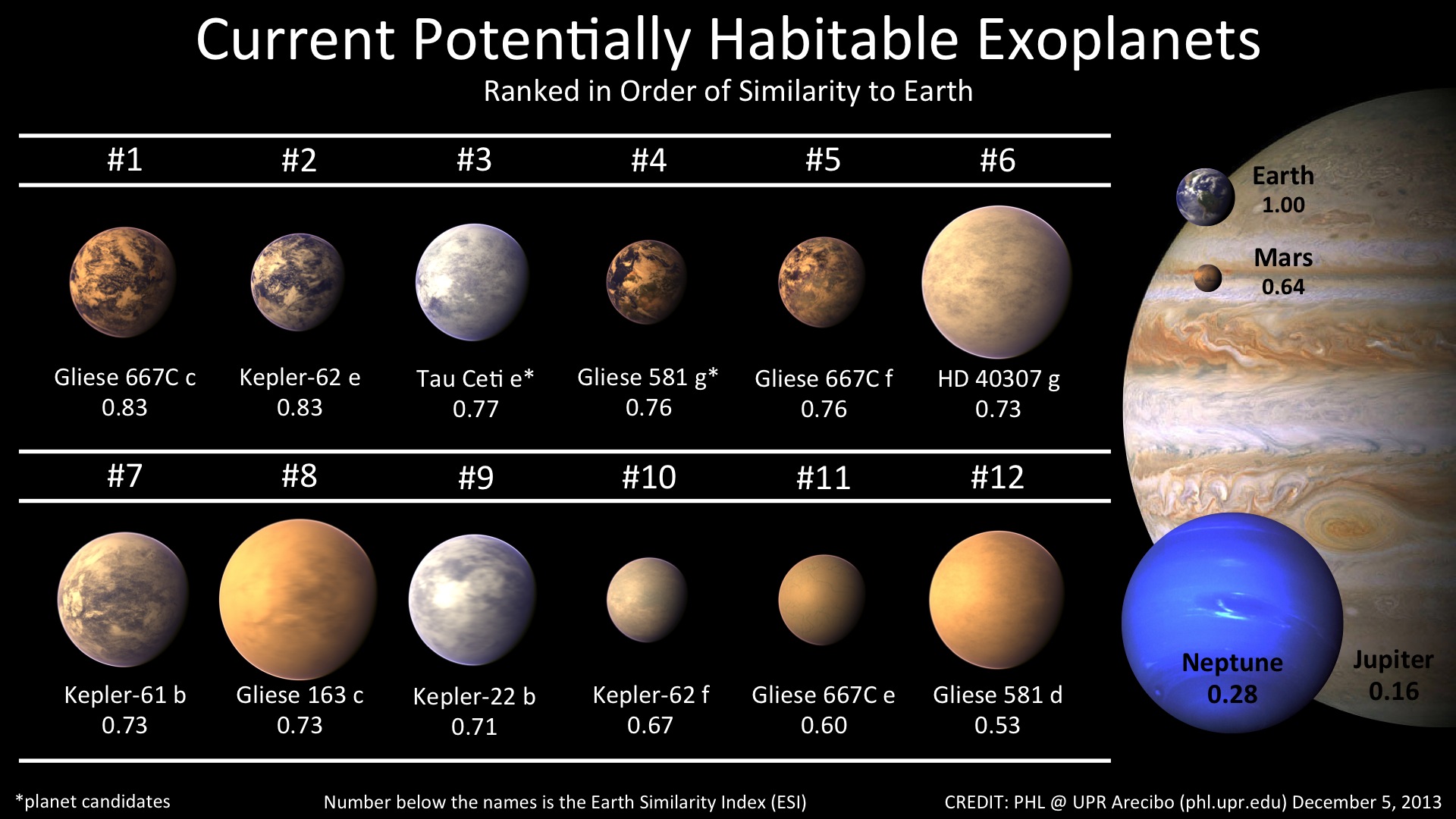
Space: Habitable Exoplanets Catalog

Photonic Space

Following discussing exoplanet mapping yesterday, here is a fantastic catalogue of exoplanets. You might like to visit this site for more details and other links to those pioneers of this new branch of space science, and of course to see the number of potential planets steadily increase over time.

The Habitable Exoplanets Catalog (HEC) is an online database for scientists, educators, and the general public focused on potential habitable exoplanets discoveries. The catalog uses various habitability indices and classifications to identify, rank, and compare exoplanets, including potential satellites, or exomoons. The catalog is updated as new data is available.

"Scientists are looking for life, as we know it, on Earth-like planets, as we measure them."

A New Habitable Zone: Earth is situated at the very inner edge of the habitable zone

Last Update: January 29, 2013
Click image for more details, click here for larger version.


Number of Potential Habitable Worlds

Potential
Habitable Exoplanets
Unconfirmed Potential
Habitable Exoplanets (1)
Candidates for Potential
Habitable Exomoons (2)
η Earth(3)
930301.6 %


All Currently Known Exoplanets


Confirmed Exoplanets (4)NASA Kepler Candidates (5)Other Unconfirmed Exoplanets (4)
8652740186


Notes

(1) Based on NASA Kepler Mission exoplanet candidates waiting for confirmation.
(2) Estimate based on the number of warm jovians with the right mass for a near Earth-size moon. None observed yet.

(3) η Earth (Eta Earth) is the stellar frequency of potential habitable exoplanets based on observed values (this is a lower limit).
(4) Confirmed and unconfirmed exoplanets are those listed by the Extrasolar Planets Encyclopedia plus any recent pending additions.
(5) Most of NASA Kepler Candidates are unconfirmed exoplanets.

Photonic Space